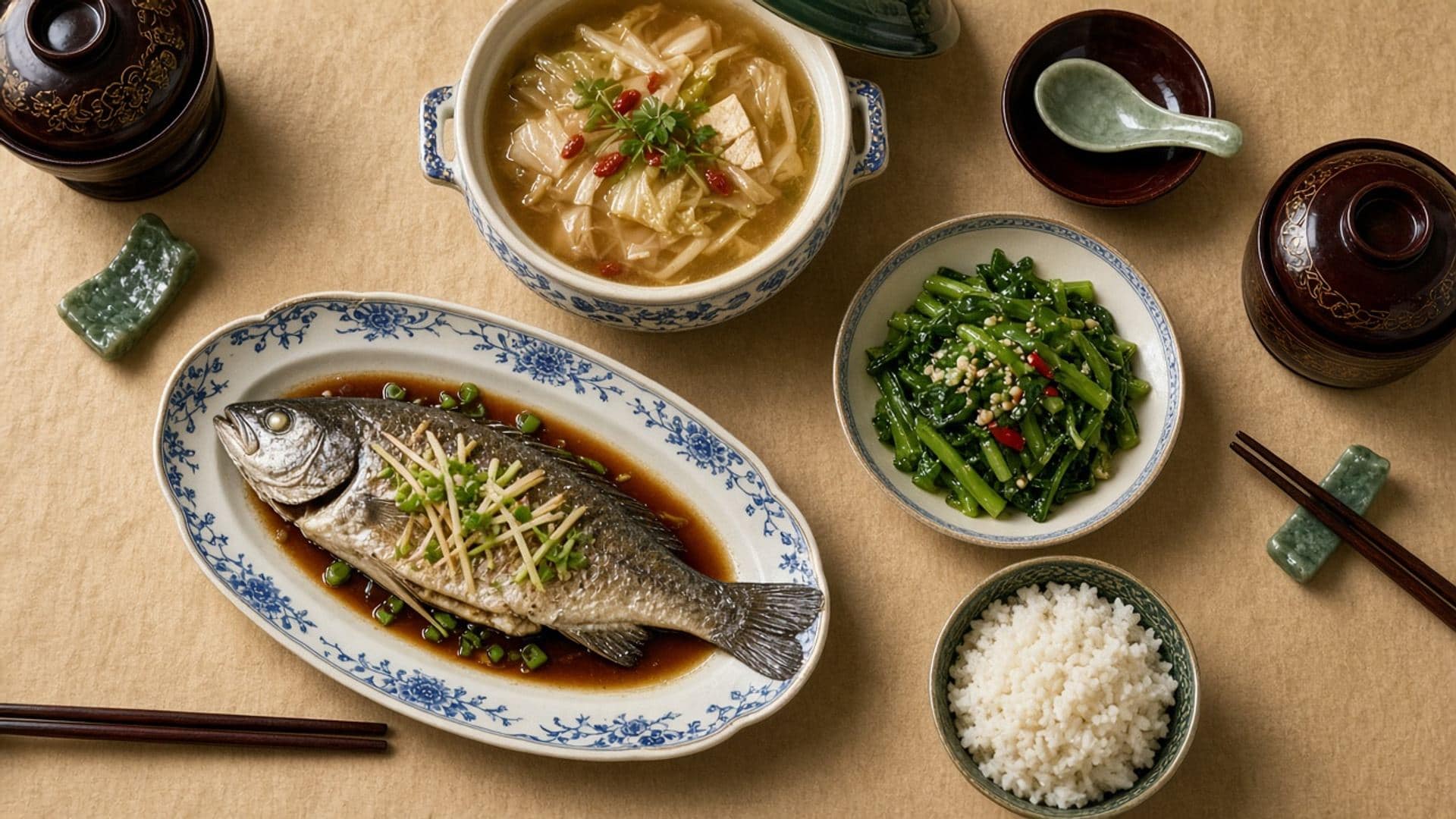
A Chinese banquet is how a lot of Melbourne families mark the nights that matter: birthdays, farewell dinners, lunar dates, a table too big for a weeknight wok. This page is the how-to: sequence, how many plates, and what to tell the room.
We will not name rooms or quote a set-menu price. Those figures go stale and they were never ours to invent. We will tell you how a banquet is shaped, what to ask, and how Melbourne’s dining geography changes the kind of room you look for.
What a banquet is
A banquet is a paced sequence served to a round or long table, usually on a lazy Susan. It is not “order seven mains at once and hope”. The kitchen wants a beginning, a middle and a close so the wok line can breathe and the table is not buried under cooling plates.
A classic Cantonese-leaning shape looks like this:
- Cold plates or a small roast platter — something to meet the tea.
- A soup, often a broth that can be poured between courses.
- A run of mains: one seafood or tofu, one poultry, one pork or beef, one vegetable that is actually a vegetable.
- A whole fish, steamed if the kitchen is proud of it.
- A starch — fried rice or noodles — after the savoury peak, not instead of it.
- A quiet sweet, fruit, or sweet soup.
Sichuan and other regional rooms will alter the seasoning, not necessarily the skeleton. You can still ask for a cold starter, a contrast of textures, and a starch at the end.
How many dishes
One dish per guest, plus one, plus rice, is a reliable Melbourne working rule for an à la carte banquet. Eight people therefore means roughly nine sharing plates plus starch, not sixteen. Leftovers are part of the hospitality. Running out of greens is a bigger failure than leaving a third of the duck.
If the room offers a set, ask how many courses and whether the fish is whole. Ask whether dietary substitutions shrink the set or just swap a plate. A set that looks cheap because it is mostly fried items is not a bargain; it is a heavy table.
Children and older relatives change the heat and the offal, not the maths. Keep one mild braise and one plain green in the plan even if the rest of the table wants chili.
Melbourne rooms and precincts
Banquet-capable kitchens in Melbourne are not only on Little Bourke Street. Suburban dining rooms in the east and south-east often have the round tables, the parking and the noise tolerance that a fifty-person family dinner needs. City rooms may be better when the guest list is already in the grid for a theatre or a hotel.
Look for evidence the room is used to large bookings: round tables, a lazy Susan that actually turns, a floor team that can pour tea without being asked twice, a menu that already speaks in “small / medium / large” or in set sequences. A tiny open kitchen with four burners can still cook beautifully for two. It may not want your twenty-first.
Chinatown remains a logical place to walk if your group is city-based. It is not automatically the right banquet room. Read the Chinatown guide for the street, then judge the specific dining room on the tests above.
What to tell the venue
Phone. Do not assume a web form on a third-party site is a confirmation. Give the date, the time, the number of people, the age mix, and the constraints: no pork, no shellfish, no chili, gluten-avoiding, vegetarian. Ask whether they need a deposit. Ask how long they will hold the table. Ask whether the fish is priced by weight — and if it is, ask them to confirm before they cook it. This site will not guess that number.
If someone at the table does not eat shared sauces, say so. If you need the room to hold a speech or a cake, say so; some dining rooms are not built for that.
We do not take the booking. If you only have a question about this guide, use contact.
At the table
Let one person be the floor contact. That person can pour tea, accept plates, and stop the kitchen when the table is full. The lazy Susan turns toward the guest, not away from them. Take from the dish in front of you; do not stand the chopsticks in the rice.
The fish is usually the pause. People photograph it. Then it should be eaten while it is still steaming. After the starch, you are allowed to be finished even if the sweet has not arrived. You are also allowed to ask them to skip the sweet.
Leftovers are normal. Ask for containers. A banquet that goes home as tomorrow’s rice is working as designed.
Who sits where
Round tables erase the head of a European table and then quietly put it back. The seat facing the door, or the seat with the least traffic behind it, is often offered to the guest or the eldest. Lazy Susans make service easier and make it obvious if one person keeps stopping the food in front of themselves. If you are hosting, watch the wheel. If you are hosted, accept a plate when it is turned to you.
Speeches sit badly in a room that is still firing a wok. Ask the floor when a natural pause will come — usually after the fish, before the starch — if someone must stand up. A microphone in a hard dining room is a choice; many Melbourne banquet rooms were not built for it.
Wine, baijiu, beer, and the toast
Some tables will toast with baijiu. You can decline a full cup and still lift a glass. Beer is common. Wine lists in suburban banquet rooms range from thoughtful to purely ceremonial. None of that is a quality score for the kitchen. The kitchen is the wok and the fish.
If you are the host, keep people watered as well as toasted. Tea should not disappear because a bottle arrived.
Dietary sets that still look like a banquet
A vegetarian banquet is a sequence, not a single tofu. Cold gluten, a mushroom or seaweed, a soup that is actually vegetable, a claypot, a green, a starch, a sweet soup — that is a shape. A gluten-avoiding banquet is harder and must be negotiated dish by dish. Do not surprise the kitchen with twelve coeliac guests on a Saturday at 7. Phone in the week. Believe them if they say they cannot.
Kids’ plates can sit beside a banquet without collapsing it. Ask for plain fried rice or steamed egg rather than forcing a chili fish on a seven-year-old and then calling the cuisine a problem.
How Melbourne kitchens pace the fire
A good banquet kitchen is a logistics desk. Cold plates are ready. Soup is held. The fish is timed to the table, not to the ticket printer. When the room gets this wrong, everything lands in eight minutes and goes cold. You can help by not adding three extra dishes twenty minutes in unless the floor agrees. You can help by saying you are eight, not “about ten”.
If a dish is wrong, say so when it lands. A wok line can recook. It cannot un-serve a fish that has sat.
Business banquets and family banquets
They look similar and they are not. A business table may want a faster fish, less offal, more obvious luxury markers. A family table may want the dishes the grandparents actually eat. Tell the kitchen which one you are. A mixed menu that tries to impress a client and comfort an aunt at once often misses both.
Melbourne can do either. The suburban round-table room is still the workhorse for family. The city room is often the workhorse for the client. The CBD hub and the greater Melbourne hub exist so you pick the geography first.
After the last plate
Ask for the bill in one piece if one person is paying. Ask for containers before the floor clears the fish you were still eating. Tip only if you want to; this site will not invent a percentage. Thank the floor if they paced you well. That is the review that matters, and it does not need a URL.
Who sits where
On a lazy Susan the honoured seat is usually facing the door, or the seat the family already treats as the head. You do not need to perform this if nobody at the table cares. You do need to not put the person who struggles to turn on the far side of a wide Susan from the greens they will actually eat. Seat mobility and hearing before you seat hierarchy. A well-paced table is kinder than a correctly photographed one.