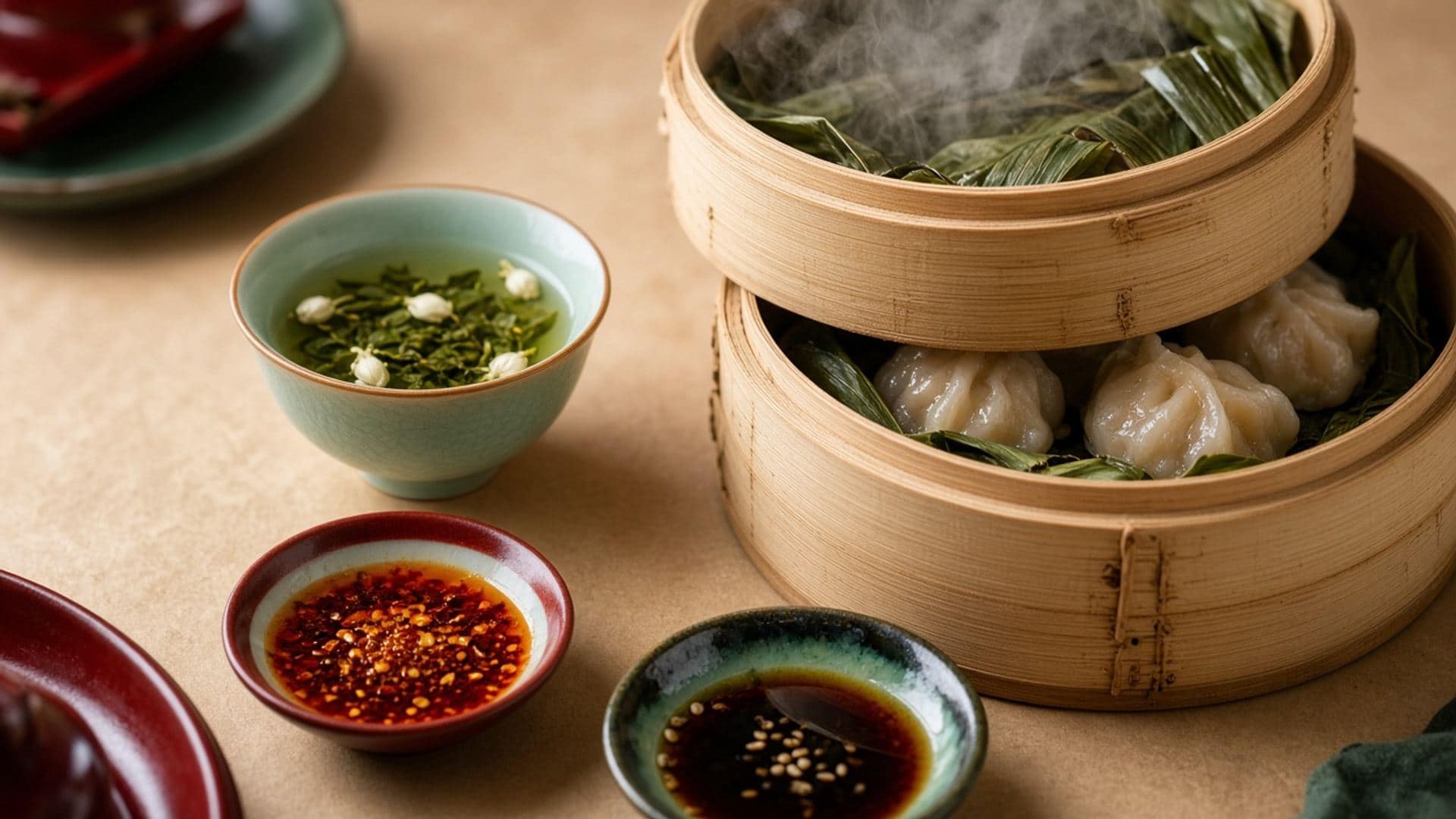
A Chinese restaurant menu is easier once you stop treating it like a European three-course list. You are not choosing a protein each. You are building a small landscape: something fresh, something rich, something green, a starch, a shared soup or tea. Yum cha is the same idea at brunch tempo.
This page is a how-to. It does not name venues. It does not invent prices. It will tell you how the room expects you to behave, because that is the part first-time diners usually get backwards.
How yum cha works
Yum cha means “drink tea”. The food is dim sum — small plates, many of them steamed. In Australia the form is usually a late-morning to mid-afternoon sitting, often loud, often built for families.
Tea arrives first. Jasmine, pu-erh, chrysanthemum or a house blend are common. If the pot is empty, lid ajar is the widespread signal for a refill. You are not meant to pour only for yourself; look after the cups around you.
Ordering is either cart or ticket. Cart service: trolleys come past; you point; the server stamps a card or notes the table. Ticket service: you tick a paper menu and the kitchen sends plates when they are ready. Both are normal. You may mix them in some rooms — tick the things the cart never carries (a particular dumpling, a plate of greens) and take the roast from a passing tray.
Share everything. A steamer is not a personal entree. Open the basket, offer it, then take a piece. If you want a second helping of the same item, ask; do not assume the next cart is identical.
A sensible opening set for two people: one prawn dumpling, one pork or vegetable dumpling, cheung fun, a dry or pan-fried item for texture, then greens or rice later. Sweets — egg tart, mango pudding, sesame balls — can arrive whenever you have space. You do not have to “save room” in a Western dessert sense; yum cha is a continuous table.
Refuse carts you do not want. It is not rude. It is how the system stays moving. It is also fine to ask for a plate that has not appeared. The floor would rather bring you har gow than watch you wait for a trolley that already went to the far room.
Reading the rest of the menu
Dinner menus are usually grouped: cold dishes, soups, seafood, poultry, pork, beef, tofu, vegetables, rice and noodles. In a Cantonese room, roast meats may have their own hanging-display logic. In a Sichuan room, the chili-oil and dry-fried section is the centre.
Order across the groups, not down one column. Four people who each pick a chicken dish have not built a meal. Four people who pick a cold starter, a fish or tofu, a green vegetable and a noodle have.
“Small / medium / large” on a banquet-style list usually refers to the dish, not a single serve. If you are two, small is often enough. If you are eight, you still want variety more than a single large tray of one thing.
Rice is not optional for most tables. Fried rice is a dish; jasmine or plain rice is infrastructure. Noodles can replace rice if the table wants them to, but a sweet sauce plus a heavy fried noodle plus no greens is a slog.
Tea, water, beer, and the bill
Tea can be charged by the pot or included. Ask if it matters to you. Ice water is common in Australia even when it would be odd in some home tables in China. Beer and wine lists vary; they are not a quality test.
Service charges and round-ups should be printed or explained. This site will not invent a tipping rule. If a set banquet is offered, get the sequence in writing so you are not surprised by a second seafood plate you did not mean to buy.
Vegetarian, vegan, and gluten-avoiding tables
Chinese restaurant kitchens use stock, oyster sauce, lard, shrimp paste and soy in places you would not guess from the English name. “Vegetable” can still mean chicken stock. “Tofu” can still mean a fish-fragrant sauce with minced meat.
Say the constraint early, in plain English, and ask what they can cook from the wok without those bases. Many rooms can do garlic gai lan, mapo tofu without mince, tomato and egg, dry-fried beans, or a mushroom stir-fry if they want to help. Some cannot, because the wok line shares sauce buckets. Believe them.
Gluten is harder. Wheat sits in soy sauce, noodle wrappers, dumpling skins, hoisin, some thickeners and some fried coatings. Rice, rice noodles, steamed fish with ginger, and many stir-fried vegetables can be workable if the soy is swapped and the wok is not already filmed with a flour sauce. Coeliac diners should not treat a Chinese restaurant as safe by default. Ask, and if the answers are vague, pick another meal.
Allergen law in Australia requires certain information to be available. It does not make a busy Saturday wok line a dedicated allergy kitchen. If the risk is serious, phone ahead.
Heat, offal, and whole animals
Spice is not one setting. Sichuan mala, Hunan fresh chili and a Cantonese chili-oil dip are different. “Mild” is a negotiation. “No chili” is clearer.
Offal, jelly fish, chicken feet and whole fish are normal food. You can skip them without a speech. If you want them, say so; they are sometimes the dishes a mixed menu hides from the first page.
A whole fish is a celebration mark. The head is offered to guests in some families. You do not have to perform a ritual you do not know. You do have to stop flipping the fish in rooms where that is considered unlucky — ask the table you came with, not the internet at large, if that matters to your group.
Paying and leaving
One person paying for the table is common. Splitting is also common in Australia. Tell the floor before they print nine receipts. Take leftovers if they are offered; the meal was built to be abundant.
If you want the home version of what you just ate, the recipe hub starts with weeknight plates, not banquet showpieces. If you want the regional why, use the cuisine map.
Cart codes, stamps, and the paper slip
Yum cha houses have local habits. Some stamp a card with a symbol for small, medium, large or special. Some use a carbon slip. Some have moved the whole thing onto a QR code. The logic is identical: the kitchen needs a record, the floor needs a tally, you need to know what you agreed to. If you do not understand the card, ask them to show you the last stamp. It is a cheaper question than arguing at the end.
Special items — a particular dumpling, a roast pigeon, a plate that is made to order — often never ride a cart. They live on the slip. If you came for those, do not wait for a trolley that will not exist.
How to share with children and older relatives
Give children a plate of their own and serve onto it. Do not ask them to fish in a communal steamer with chopsticks they are still learning. Mild steamed items, egg dishes and plain rice are the usual peace offerings. Chili oil stays in the middle, not at their rim.
Older relatives may want the first pour of tea, the fish cheeks, or the seat facing the door. Follow the table you came with. If you are the outsider, you will not offend anyone by offering, waiting, and not grabbing.
Chopsticks, spoons, and the lazy Susan
You may ask for a fork. That is normal in Australia and not a verdict on the kitchen. A ceramic spoon is the right tool for soup dumplings and broth. The lazy Susan is not a toy; load it so the soup is not climbing over the fried item. Stop the wheel when someone is serving. These are small courtesies that keep a loud room kind.
If you drop a piece, leave it. If you need a clean plate, ask. Do not wipe a shared utensil on the tablecloth and return it.
What “set lunch” is doing
Many Australian Chinese rooms still run a midweek set: soup, a small spring roll or salad, a main, rice. It is a different form from a shared dinner. You can eat it alone without feeling you have broken the cuisine. You can also ignore it and order two shares if there are two of you. The set is a pacing tool for office hours, not a cultural rule.
Leftovers, reheating, and the next day
Take the leftovers if they are offered. Reheat rice until it is steaming hot. Do not leave cooked rice on a warm bench because the walk home was long. Seafood you are unsure about should be eaten the first time. Fried items will not be the same; they can still be a lunch. The banquet instinct toward abundance assumes a fridge.
When the room is wrong
If the oil smells old, if the greens are army-grey, if the floor cannot name an ingredient, you can pay for the tea and leave. You do not owe a full banquet to a kitchen that is not cooking. This guide is not a loyalty programme.
When the room is right, stay long enough to order the green vegetable you skipped. That plate is often the one that tells the truth.